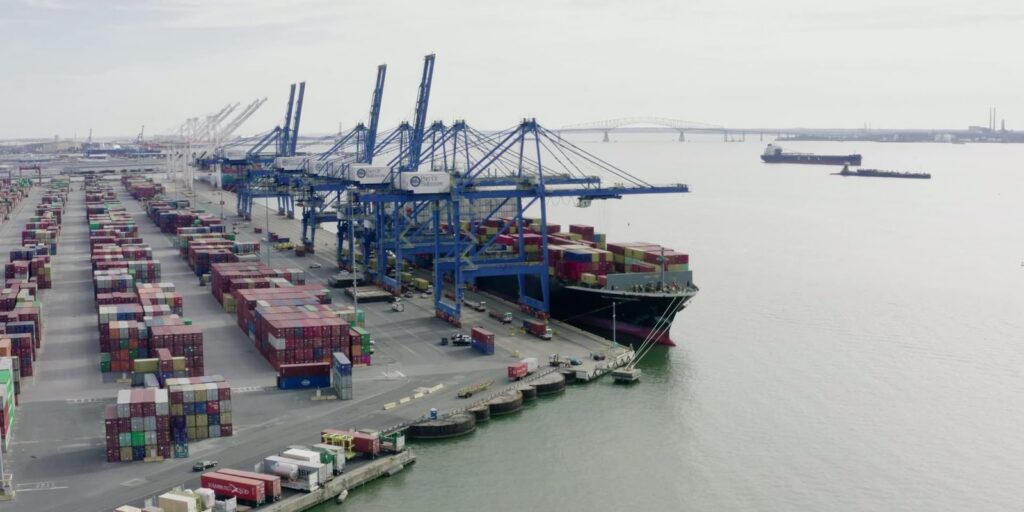
Every year the shipping journal Lloyd’s List ranks the world’s container ports by the containers they handle, counted in TEU (one TEU is one twenty-foot container; a forty-foot container counts as two). In 2025 the ten busiest ports handled almost 320 million TEU between them. Six of them are in mainland China, and only one is outside East and South-East Asia.
| # | TEU handled in 2025 | |
|---|---|---|
| 1 | Shanghai, China | 55.1 million |
| 2 | Singapore | 44.7 million |
| 3 | Ningbo-Zhoushan, China | 43.9 million |
| 4 | Shenzhen, China | 35.4 million |
| 5 | Qingdao, China | 32.9 million |
| 6 | Guangzhou, China | 28.1 million |
| 7 | Busan, South Korea | 24.9 million |
| 8 | Tianjin, China | 24.0 million |
| 9 | Dubai (Jebel Ali), United Arab Emirates | 15.6 million |
| 10 | Port Klang, Malaysia | 15.1 million |
The ten ports, one by one
1. Shanghai, China
Number one for the 16th year in a row, more than 10 million TEU ahead of Singapore. Much of its traffic goes through Yangshan, a deep-water port built on islands in the East China Sea and linked to the mainland by a bridge of about 32 km.
2. Singapore
The world’s largest transshipment hub: most containers here change ships rather than enter the country. Its new port at Tuas, fully automated, is being built in four phases and will handle 65 million TEU when it is complete in the 2040s.
3. Ningbo-Zhoushan, China
Third for containers, but first in the world for total cargo for 17 years in a row: more than 1.4 billion tonnes in 2025, iron ore, crude oil and coal included.
4. Shenzhen, China
Next to Hong Kong, it ships the output of the Pearl River Delta, one of the world’s largest manufacturing regions, through terminals such as Yantian and Shekou. Electronics and consumer goods from south China often start their sea journey here.
5. Qingdao, China
The main port of Shandong province in northern China. Its Qianwan terminal was among the first fully automated container terminals in Asia.
6. Guangzhou, China
Most of its containers go through Nansha, on the Pearl River estuary. Together, Guangzhou and Shenzhen handled more than 63 million TEU in 2025, more than Shanghai.
7. Busan, South Korea
South Korea’s largest port. More than half of its containers are transshipment: they arrive on one ship and leave on another (55% in 2024).
8. Tianjin, China
The sea gateway of Beijing and of northern China, about 150 km from the capital.
9. Dubai (Jebel Ali), United Arab Emirates
The only port of the top ten outside East and South-East Asia, and the largest in the Middle East: a hub between Asia, the Gulf, Africa and Europe.
10. Port Klang, Malaysia
Malaysia’s largest port, on the Strait of Malacca, one of the busiest sea lanes in the world.
What it means for shipments to and from Tunisia
Most containers from China to Tunisia start at one of these ports: Shanghai, Ningbo, Shenzhen, Qingdao, Guangzhou or Tianjin, depending on where the supplier is. They rarely sail straight to Radès or Sfax: the large ships call at a hub in the Mediterranean, where the container moves to a smaller ship for Tunisia.
Loading at the port closest to your supplier saves trucking costs inside China, and a well-chosen hub saves days. We look at the port of loading and the routing in every quote; see what makes up the price of a container from China to Tunisia and our sea freight service.
Sources
- Lloyd’s List One Hundred Container Ports 2026, 2025 figures (published by Visual Capitalist)
- Seatrade Maritime: Ningbo-Zhoushan, the first port to handle 1.4 billion tonnes
- Maritime Professional: the fully automated Tuas port
- City of Busan: container results by year
Figures checked on 30 October 2026. Ports publish their own figures, which can differ slightly from the ranking.
Planning a shipment? Request a quote with every fee included upfront, or talk to our team in Tunisia: +216 70 295 255, info@kyranislogistics.com.

Comments
Ask a question or share your experience.
No comments yet. Be the first to ask a question.