
Did you know that the freight rate is only one of three layers of what a container costs, and that the third is paid in Tunisia after the goods arrive? A container costs money three times over: as a box, as cargo on a ship, and as a guest at the terminal. Importers who only compare freight rates get surprised at the end. Here are the three layers, with figures as of 9 November 2026.
Layer one: the box itself
Most shippers never buy a container: the line supplies it with the freight, and the price of the box is spread over its 12 to 15 years of service. You pay for the box only when you own it, as a shipper-owned container: for a one-way move with storage at the other end, for a project site, or for goods that stay in the box for months.
What a box costs in November 2026, at a US depot and before delivery: a used 20-foot container in cargo-worthy condition about $2,050, new (one trip) about $2,750; a used 40-foot about $2,500 and a new 40-foot high cube about $3,850. A used 40-foot reefer sells for $3,000 to $6,500 depending on the age of its cooling unit, and a new 20-foot reefer for $6,000 to $9,000. European and Tunisian depot prices differ, but the order of magnitude is the same.
Owning the box changes the bill at the terminal too: at Radès, a shipper-owned container pays no demurrage or detention to the line, but it does pay the port's storage, and the empty box is yours to move, sell or ship back.
Layer two: the voyage
Drewry's World Container Index stood at $4,389 per 40-foot container on 5 November 2026, 1% lower than the week before but more than twice its level a year ago. Shanghai to Genoa, the Mediterranean benchmark closest to Tunisia, was $4,166; Shanghai to Rotterdam $3,615.
The rate on a quote is rarely the whole voyage. On top of it come the bunker surcharge, the peak season surcharge, general rate increases announced for the 1st or the 15th of a month, and local surcharges, such as a congestion surcharge at the port of discharge. Our post on general rate increases explains how these announcements work, and what makes up the price of a container from China to Tunisia lists every line, stage by stage.
Layer three: the terminal
The third layer is the one importers forget, because it is paid in Tunisia, in dinars, after the goods have arrived. Four items make it up.
- Terminal handling charges, at both ends: the crane lift, the moves in the yard, the gate. Around $150 per 20-foot unit in the large Chinese ports, €195 to €200 in Rotterdam, Hamburg or Antwerp; a 40-foot pays about one and a half times a 20-foot. The line collects them, the terminal keeps them.
- Port dues and storage: at Radès they are paid to the port operator STAM, not to the shipping line, and they are never included in the freight or in the line’s free days.
- The delivery order and the agent’s documentation fees, due before the container can leave the port.
- Demurrage and detention, the price of time: the line’s compensation when its container stays with you beyond the free days, inside the terminal (demurrage) or outside it (detention).
What the clock costs at Radès
Maersk's import tariff for Tunisia counts demurrage and detention together, in calendar days from the day the container is discharged. A dry container has 12 free days. From day 13 to day 21 it costs TND 33 a day for a 20-foot and TND 66 for a 40-foot; from day 22, TND 39 and TND 83. A reefer has only 5 free days, then TND 132 a day, and TND 154 from day 11. MSC also gives 12 free days at Radès. Public holidays count. The port's storage comes on top, on its own tariff.
Twelve days sound like plenty. At Radès they go quickly: the vessel is discharged on a Friday, the documents arrive on Tuesday, a customs query takes a week, and the container leaves on day 20. Our post on the ten mistakes that hold a container at Radès shows where the days are lost, and demurrage and detention: how to avoid them gives the remedies.
How to read a quote
A good quote shows the three layers, each on its own line, and says what is excluded. Ask for the terminal charges at both ends, the delivery order, the free days and the daily rate after them, and the storage tariff of the port. Then compare total against total: a cheaper freight rate with 7 free days can cost more than a dearer one with 14. Whether a quote ends at the terminal or at your door is set by the service terms, which our post on CY to CY, CY to door and door to door explains.
What we recommend
- Ask for a door-to-door quote with every line listed, and keep it: it is the only fair way to compare offers. Our quote shows terminal charges, delivery order and free days.
- Prepare the customs file before the vessel arrives, not after; most of the days lost at Radès are documents.
- Agree the free days in writing when you book, and put them in your sales contract with the supplier when the supplier books the freight.
- Estimate before you ship with our freight tools: the landed cost calculator for the import costs into Tunisia and the demurrage calculator for the price of each extra day. The answers to the most common questions about fees are in our FAQ.
- Buying a box? Our post on container types says which one fits your cargo, and our sea freight team moves shipper-owned containers too.
Sources
- Shipping-containers.com, shipping container prices by size and condition, updated 8 November 2026
- Drewry, World Container Index, 5 November 2026
- Maersk, Tunisia import local information: demurrage and detention tariff effective 1 January 2025
- MSC, Tunisia local information: free time and storage at Radès
- GoFreight, terminal handling charges explained, 2026
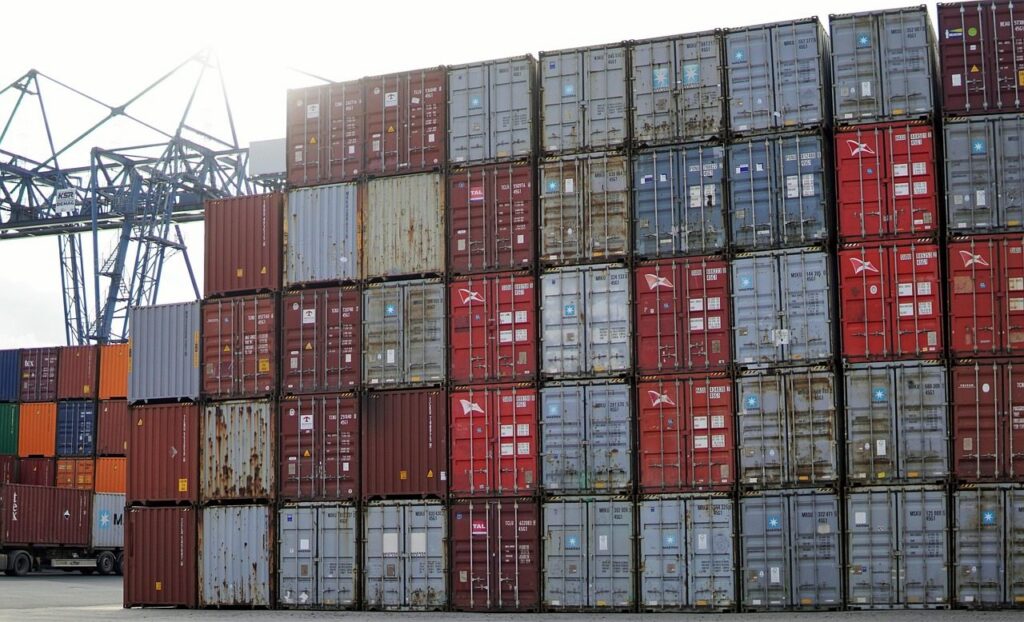
Picture: containers stacked under a crane, by Mylene2401, Pixabay. Box prices are US depot medians before delivery; terminal handling charges are indicative ranges from the source, not a Radès tariff; demurrage and detention are Maersk's published import tariff for Tunisia, other lines differ. Your costs depend on the line, the terminal and the date: ask for a quote.
Planning a shipment? Request a quote with every fee included upfront, or talk to our team in Tunisia: +216 70 295 255, info@kyranislogistics.com.

Comments
Ask a question or share your experience.
No comments yet. Be the first to ask a question.