
You book a container from Shanghai to Radès and the tracking shows two ship names, with a stop of several days in between. Nothing has gone wrong. The container was transshipped: unloaded at a port on the way and loaded onto a second ship. This is how most containers reach ports the size of ours, and it is worth knowing what it changes.
What transshipment is
Transshipment means that a container leaves its first ship at a port on the way, waits in the terminal, and continues on another ship. The port where this happens is called a hub. The container stays sealed and is not opened; only the ship changes.
Shipping lines work like airlines. Very large ships sail between a small number of hubs. Smaller ships, called feeders, carry the containers between each hub and the ports around it. This is known as a hub and spoke network.
Why shipping lines do it
- Size: the largest container ships are too big for many ports, and they pay only when they sail full between a few large ports.
- Reach: with one change of ship at a hub, a line connects hundreds of pairs of ports without sailing a ship between each of them.
- Frequency: a small port gets a feeder every week instead of a large ship once in a while.
What it means for Tunisia
Tunisian ports are served mostly by feeders and short-sea ships. A container between Tunisia and Asia or the Americas therefore usually changes ships at least once at a hub in the Mediterranean, such as Tanger Med, Algeciras, Valencia, Marsaxlokk in Malta, Gioia Tauro or Piraeus. Several of them appear in the 10 biggest container ports in the world.
Between Tunisia and the nearby ports of Europe, many services are direct, and the question does not arise. The further away the other port is, the more likely a change of ship becomes.
What changes for your shipment
- Time: the days in the hub are part of the journey. A good connection takes a few days; a poor one can take more than a week.
- A missed connection: if the first ship arrives late or the feeder is full, the container waits for the next sailing, often a week later. The trade says the container was rolled.
- Handling: every change of ship means two more lifts by crane. The container stays closed, but goods that are badly secured inside suffer with each lift.
- Tracking: the name of the ship changes on the way. Follow the container number, not the ship.
- Documents: one bill of lading normally covers the whole journey, and the goods are not cleared through customs at the hub.
When a hub is congested, the wait there is the first thing to grow. The warning signs are in port congestion: causes, warning signs and costs.
What to ask before you book
A direct service and a service with transshipment can both be the right choice. A direct ship is simpler; a route through a hub often sails more often and can cost less. These questions show what you are buying:
- Is the service direct, or through which hub?
- How many times does the container change ships?
- How many days are planned between the two ships?
- What happens, and who informs you, if the connection is missed?
How to plan around it
- Add a margin of about a week to the arrival date when the route includes a change of ship, and more in the peak season.
- For goods that cannot wait, such as chilled food, choose the route with the fewest changes, even at a higher price.
- Secure the goods inside the container for several lifts, not for one.
- Check that your insurance covers the whole journey, including the stay in the hub: see cargo insurance: why carrier liability is not enough.
- Plan the collection at destination around the real arrival, so that the free days are not lost: see demurrage and detention: how to avoid them.
In short
- Transshipment is a change of ship at a hub; the container stays sealed.
- It is normal for ports served by feeders, including the Tunisian ports on long routes.
- It adds days and one risk, the missed connection. Ask which hub, how many changes and how many days between ships.
What to do now
- Before your next booking, ask for the routing in writing: ports, ships and planned dates. Our sea freight page shows the routes we arrange.
- Tell us what you ship, from where to where and by when, and ask us for a quote: we name the route, the hub and the time to allow.
Sources
- Hapag-Lloyd: understanding the hub and spoke system in container shipping
- Port Economics, Management and Policy: the insertion and location of transshipment hubs
- Tradlinx: transshipment rollovers and missed feeders
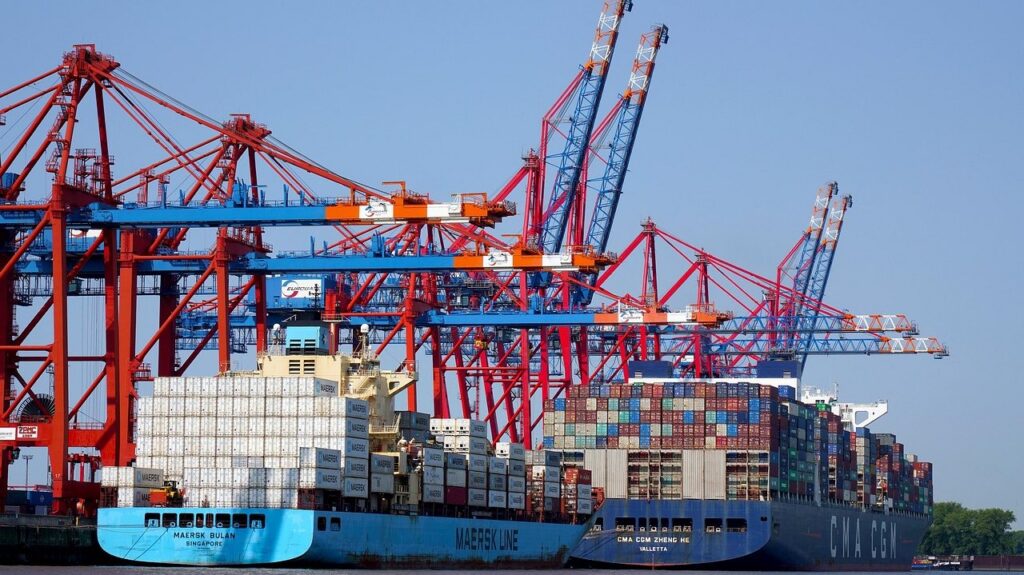
Photo: two ships under the cranes of a container terminal, by makabera, Pixabay. General information: routes and connection times differ by shipping line and season; ask for the routing of your own shipment.
Planning a shipment? Request a quote with every fee included upfront, or talk to our team in Tunisia: +216 70 295 255, info@kyranislogistics.com.

Comments
Ask a question or share your experience.
No comments yet. Be the first to ask a question.