
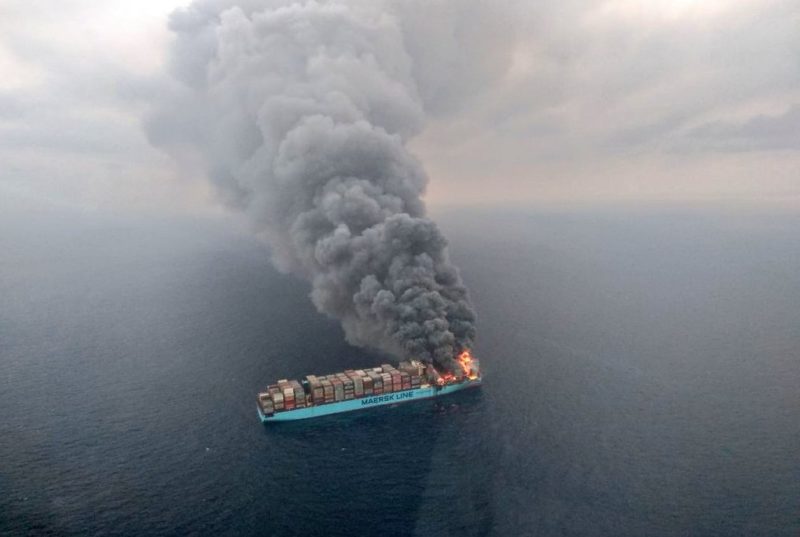
On 6 March 2018 one of the newest container ships in the world caught fire in the middle of the Arabian Sea. The Maersk Honam was less than a year old and carried 7,860 containers. The fire killed five of her 27 crew, burned for weeks and turned into one of the most expensive container ship losses of its time. For shippers it is also a lesson in two things that rarely make the news: dangerous goods and general average.
The ship
Maersk Honam was built by Hyundai Heavy Industries in Ulsan, South Korea, and delivered in August 2017. She was 340.5 metres long, could carry 15,226 TEU and flew the flag of Singapore. In March 2018 she was sailing from Singapore to Suez, on the way to Europe, with 7,860 containers on board.
What happened
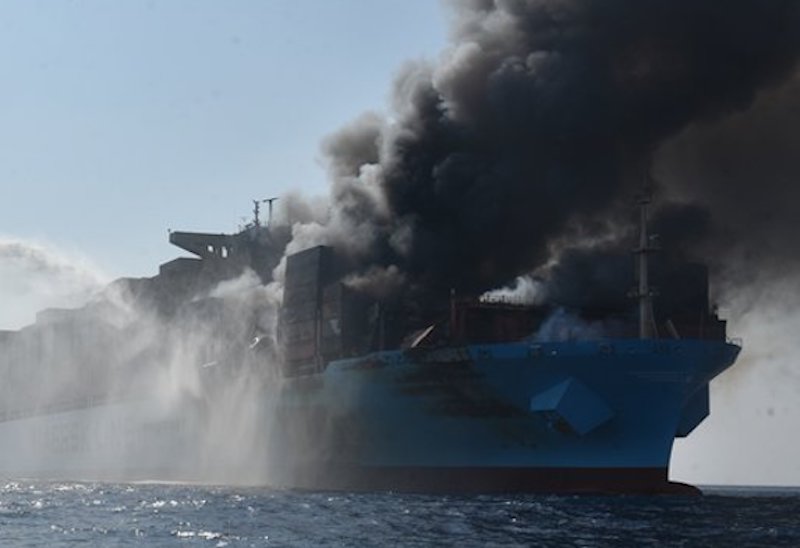
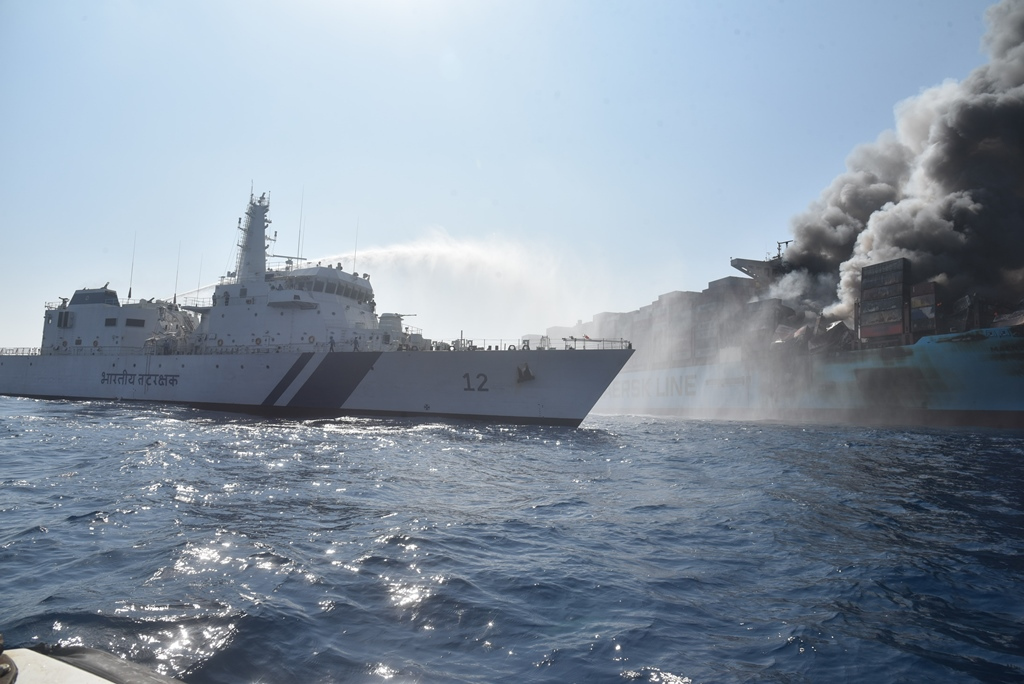
The fire started in cargo hold number 3, in front of the accommodation block, when the ship was about 900 nautical miles south-east of Salalah, Oman. The crew released the ship's carbon dioxide system into the hold, but the fire spread. About two and a half hours after it began, they abandoned ship. The merchant ship ALS Ceres picked up 23 seafarers; one of them died the next day. Four others were never found alive. Ships of the Indian Coast Guard and offshore vessels fought the fire, and it was brought under control on 9 March, but hot spots kept burning into April.
- August 2017Delivered by Hyundai Heavy Industries.
- 6 March 2018Fire in hold 3; the crew abandon ship; five seafarers die.
- 9 March 2018Fire under control; Maersk declares general average.
- Spring 2018Towed to Jebel Ali, Dubai; the intact cargo is unloaded.
- August 2019Back in service as Maersk Halifax, with a new forward section.
- October 2020Singapore's investigators publish their final report.
What the investigators found
Singapore's Transport Safety Investigation Bureau could not prove the cause, because most of the evidence had burned. It ruled out electrical faults, heating of the fuel tanks and wrongly declared goods. The most likely source was a block of 54 containers holding about 1,000 tonnes of sodium dichloroisocyanurate dihydrate, a chemical used to disinfect swimming pools and water. It was correctly declared and stowed under class 9, the class for miscellaneous dangerous goods, but tightly packed in large amounts it can break down by itself and give off heat and toxic gases. Survivors spoke of thick white smoke and a smell of bleach. The investigators also found that 16 vent flaps of the hold could not be closed, which weakened the carbon dioxide.
They recommended:
- temperature sensors in cargo holds, linked to the fire alarm;
- special containers for dangerous goods that fight a fire inside them by themselves;
- a review of how this chemical is classed, and stowing it on deck, away from heat;
- a review of the firefighting rules for container ships.
The bill for cargo owners: general average
Three days after the fire, Maersk declared general average, a rule of the sea that is centuries old: when cargo or the ship is sacrificed, or money is spent, to save the whole voyage, everyone with goods on board shares the cost. The adjuster asked each cargo owner for security of 42.5% of the cargo's CIF value for the salvors and 11.5% for general average, 54% in all, before releasing any container. That applied to undamaged containers as well. Shippers with cargo insurance had their insurer sign a guarantee; those without had to find the money themselves, and waited.
What became of the ship
The burnt bow and the accommodation block were cut off and scrapped in Dubai. The stern, with the engine room, was carried to South Korea on a semi-submersible ship, and Hyundai Heavy Industries built a new forward section onto it. The ship went back into service in August 2019 as Maersk Halifax, keeping the same IMO number, and was later converted to run on methanol.
What it teaches shippers in Tunisia
- Declare dangerous goods exactly, with the safety data sheet. Even correctly declared cargo can be dangerous; wrongly declared cargo puts every ship and crew at risk.
- Insure every sea shipment, even goods that seem hard to damage: in general average, intact cargo pays too. Why carrier liability is not enough.
- Keep the commercial invoice and the CIF value of each shipment ready: the adjuster and the insurer ask for them first.
- Work with a forwarder who follows the vessel and talks to the insurer and the adjuster for you. Our sea freight team does it for shipments from and to Radès and Sfax.
Sources
- Wikipedia: Maersk Honam (ship, voyage, crew, rebuilding)
- The Maritime Executive, 21 October 2020: report says dangerous chemical may have caused Maersk Honam fire (TSIB final report MIB/MAI/CAS.035)
- The Loadstar, March 2018: shippers with cargo on Maersk Honam must pay to get it released
- Wikimedia Commons: photos of the Indian Coast Guard
Photos: Indian Coast Guard, under the Government Open Data License – India. The CIF value is the value of the goods with insurance and freight to the port of destination.
Planning a shipment? Request a quote with every fee included upfront, or talk to our team in Tunisia: +216 70 295 255, info@kyranislogistics.com.

Comments
Ask a question or share your experience.
No comments yet. Be the first to ask a question.