
A shipment can be stopped at the border because of the wood under it. Raw wood can carry insects and diseases that kill living trees, so wood packaging in international trade follows one standard: ISPM 15, adopted under the International Plant Protection Convention (IPPC) and published by the Food and Agriculture Organization of the United Nations (FAO). The wood is treated, then stamped, and the stamp is the proof. This guide explains what the rule covers, how to read the stamp, and where shipments get stuck.
Which packaging the rule covers
ISPM 15 covers packaging made of raw wood, the kind found under or around almost any shipment:
- pallets, box pallets and pallet collars;
- crates, boxes and packing cases;
- cable drums, spools and reels;
- dunnage: the loose wood used to block, brace and support the goods.
The rule looks at the wood, not at the goods. A shipment of machine parts or textiles is concerned as soon as it travels on wood.
What is exempt
The standard exempts wood that carries a sufficiently low risk:
- packaging made entirely of thin wood, 6 mm thick or less;
- packaging made wholly of processed wood, such as plywood, particle board, oriented strand board or veneer, produced with glue, heat or pressure;
- barrels for wine and spirits that were heated during manufacture;
- sawdust, wood shavings and wood wool;
- wooden parts that are permanently attached to freight vehicles and containers.
Pallets made of plastic, metal or cardboard are not wood packaging, so the rule does not apply to them. A crate with plywood walls on runners of raw wood is not exempt: the runners must be treated and stamped.
The four approved treatments and their codes
The wood must be debarked, then treated by one of four approved methods. Each method has a code of two letters, which appears in the stamp:
| Code | Treatment | What the standard requires |
|---|---|---|
| HT | Heat treatment | At least 56 °C for at least 30 continuous minutes, through the whole piece of wood, its core included. |
| DH | Dielectric heating (microwaves or radio waves) | At least 60 °C for 1 continuous minute, through the whole piece of wood, its surface included. |
| MB | Fumigation with methyl bromide | Not allowed when a piece of wood is more than 20 cm across at its smallest dimension. |
| SF | Fumigation with sulphuryl fluoride | The same limit of 20 cm; not allowed for wood with a moisture content above 75%. |
Debarked does not mean free of every trace of bark. Small, separate pieces may remain if they are less than 3 cm wide, or wider but smaller than 50 square centimetres each.
The Convention encourages countries to replace methyl bromide with the other treatments. In Tunisia, heat treatment is the only option: methyl bromide has been banned there by a government decree since 2015, and the national programme for wood packaging keeps heat treatment alone.
How to read the stamp
A treated unit carries the official mark. It is a rectangle or a square with a border, split by a vertical line: the symbol on the left, the codes on the right.
- The symbol: the letters IPPC next to a stylised ear of wheat.
- The country code: two letters, such as TN for Tunisia, FR for France or CN for China.
- The producer code: the number that the national plant protection authority gave to the company that treated the wood or made the packaging. It follows the country code after a hyphen.
- The treatment code: HT, DH, MB or SF, on a line of its own or after a hyphen.
The standard shows the layout with the example “XX-000 YY”: country XX, producer number 000, treatment YY. A stamp ending in HT therefore means heat-treated wood.
- The stamp must be legible, durable and not transferable.
- It must be visible when the packaging is in use, preferably on at least two opposite sides.
- It must not be drawn by hand.
- Red and orange are avoided, because these colours are used on the labels of dangerous goods: see shipping dangerous goods: the basics.
The stamp replaces paperwork: according to the standard, a stamped unit needs no phytosanitary certificate for its wood. Only companies authorised by their national plant protection authority may apply it. This concerns the packaging only: the goods on the pallet can still need a certificate of their own.
Reused, repaired or rebuilt pallets
- Reused as it is: a unit that was treated and stamped, and has not been repaired or altered, needs no new treatment and no new stamp during its whole service life.
- Repaired: up to about one third of its parts were replaced. Only treated wood or processed wood may be used, and each new part of treated wood must carry its own stamp.
- Rebuilt (the standard says remanufactured): more than about one third of its parts were replaced. Every old stamp must be removed for good, for example painted over or ground off; the unit is then treated again and stamped again.
- In case of doubt about a repaired unit, the authority can require the old stamps to be removed and the unit to be treated and stamped again. Several stamps on one unit are not a fault in themselves.
When you buy second-hand pallets for export, ask the seller who repaired them, and whether that company is registered for ISPM 15.
Dunnage: the wood that is forgotten
The wood that blocks and braces the goods inside a container or on a truck falls under the same rule as the pallets. It is often cut to length only during loading, which makes it easy to overlook.
The standard asks shippers to make sure that every piece of dunnage is treated and shows a complete, legible stamp. Small offcuts that do not show the whole stamp should not be used.
Where the rule applies
- European Union: wood packaging that enters from any country outside the Union, except Switzerland, must be debarked, treated and stamped. The authorities check it on a risk basis, together with customs.
- Inside the European Union: the rule does not generally apply to trade between member states, with exceptions for certain areas where certain pests are present.
- United Kingdom: solid wood packaging must meet ISPM 15 to enter Great Britain. Since 1 January 2021 this also applies to trade between Great Britain and the European Union.
- Tunisia, for export: the plant health authority of the Ministry of Agriculture runs a compliance programme. Sawmills, makers and repairers of wood packaging and heat treatment companies register with it, and receive the registration number that goes into their stamp.
Most countries outside the European Union apply the standard as well. Before you ship to a new destination, check its rule with your freight forwarder or with that country's plant protection authority. For the documents of a shipment from Tunisia to the European Union, see our document checklist.
What happens when the wood fails the check
When a unit carries no stamp, or when live pests are found, the authority of the importing country can act. The standard names these measures:
- detention of the shipment while the case is examined;
- removal of the wood that does not comply, which means repacking the goods;
- treatment of the wood;
- destruction of the wood, or return of the shipment.
The costs follow the shipment. In the United Kingdom, for example, the official guidance warns traders that they can be asked to pay for the repacking, the treatment, the destruction or the return. While the container waits, storage and demurrage can add up: see demurrage and detention: how to avoid them.
In short
- Under ISPM 15, packaging of raw wood thicker than 6 mm must be debarked, treated and stamped: pallets, crates, drums and dunnage alike.
- The stamp shows the symbol, the country, the producer and the treatment: HT, DH, MB or SF.
- A stamped pallet can be reused without a new treatment. A repaired or rebuilt one needs a second look.
What to do before you ship
- Order export pallets and crates from a registered supplier, and write “ISPM 15, stamped” on the purchase order.
- Look at the wood before loading: a complete, legible stamp on each pallet and each crate, on two opposite sides if possible.
- Check the dunnage as carefully as the pallets, and keep untreated offcuts out of the container.
- Importing? Ask your supplier to confirm in writing that all the wood packaging is treated and stamped.
- Planning the load? See how many pallets fit in a container and packing and palletising for export. For customs formalities in Tunisia, see our customs clearance service, or ask us for a quote.
Sources
- International Plant Protection Convention (FAO): ISPM 15, Regulation of wood packaging material in international trade (PDF)
- European Commission: wood packaging material, requirements at EU entry (factsheet, PDF, copy published by the Finnish Food Authority)
- Ireland, Department of Agriculture, Food and the Marine: wood packaging material and ISPM 15
- United Kingdom government: wood packaging for import and export
- Tunisia, Ministry of Agriculture: compliance programme for wood packaging under ISPM 15 (PDF, in French)
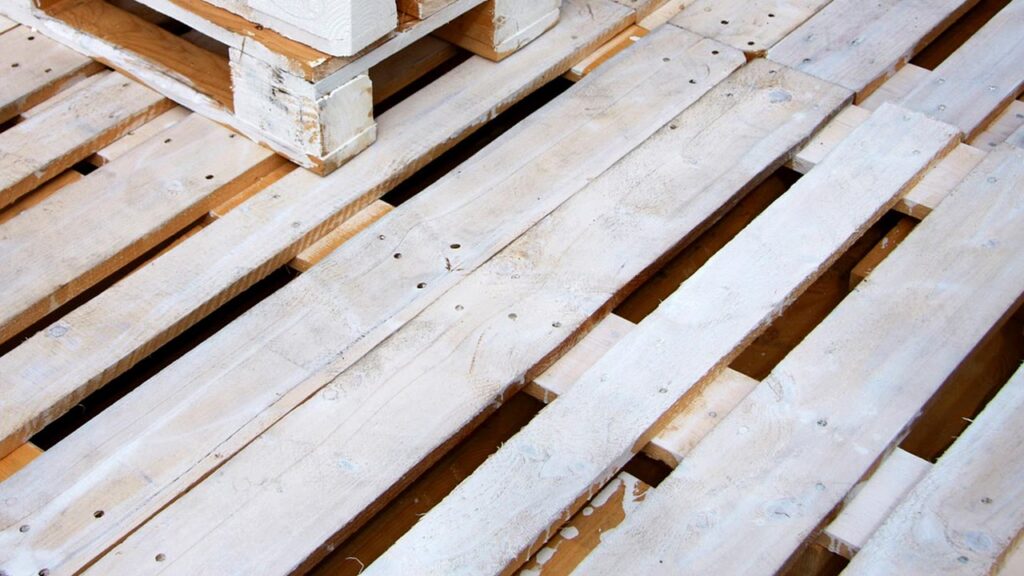
Photo: wooden pallets, by ivoxis, Pixabay. This guide is a summary in our own words. It does not replace the standard or the rules of the country of destination.
Planning a shipment? Request a quote with every fee included upfront, or talk to our team in Tunisia: +216 70 295 255, info@kyranislogistics.com.

Comments
Ask a question or share your experience.
No comments yet. Be the first to ask a question.