
How many pallets go into a container is the first question when you plan a full load: the answer decides between one container and two. It depends on the pallet, on the container, and on how the pallets are turned. The counts below are for one layer on the floor. We worked them out from the inside measurements of the containers.
The counts at a glance
Pallets in one layer, with goods that do not hang over the edge of the pallet:
| Container | Floor inside (length × width) | Euro pallets (120 × 80 cm) | ISO pallets (120 × 100 cm) |
|---|---|---|---|
| 20-foot | 5.90 × 2.35 m | 11 | 10 |
| 40-foot and 40-foot high cube | 12.03 × 2.35 m | 24 | 21 |
| 20-foot reefer | 5.45 × 2.29 m | 10 | 9 |
| 40-foot high cube reefer | 11.58 × 2.28 m | 23 | 20 |
These counts leave at least 10 cm of play along the container, which you need to load the last pallets and to secure them. Containers differ by a few centimetres from one to the next: for a load planned to the last pallet, ask for the inside measurements of the container you will get.
Two pallets, two counts
- The Euro pallet measures 120 × 80 cm. It is the standard in Europe, on the road and in most warehouses.
- The ISO pallet, also called the industrial pallet, measures 120 × 100 cm. It is common in industry and in many markets outside Europe.
A container is about 2.35 m wide inside. Two pallets never stand side by side on their long side, because 2 × 120 cm is 2.40 m. That is why the count depends on how the pallets are turned.
How the pallets are placed
In a 20-foot container, Euro pallets stand in two rows: 4 pallets placed lengthwise in one row and 7 placed crosswise in the other. Together the two rows are 2.00 m wide and hold 11 pallets.
In a 40-foot container, the best plan turns the pallets partway: each row starts with pallets placed one way and ends with pallets placed the other way. This gives 24 Euro pallets, with about 40 cm to spare. A 25th pallet fits only to the centimetre: 10 pallets placed lengthwise measure 12.00 m in a container of 12.03 m. If one carton hangs over, the last pallet stays behind. Plan with 24.
ISO pallets are placed in the same way, each row turned partway: 10 in a 20-foot container and 21 in a 40-foot.
Reefer containers take fewer
- The insulated walls and the cooling unit take space: a reefer is about 2.29 m wide inside instead of 2.35 m, and its floor is shorter. A 20-foot reefer takes 10 Euro pallets or 9 ISO pallets; a 40-foot high cube reefer takes 23 or 20.
- ISO pallets leave less than 10 cm across a reefer (120 + 100 cm in about 2.29 m). Nothing may hang over the pallet.
- The cold air comes out of the floor and returns under the roof. Load no higher than the red line marked inside the container, so that the air can return.
High cube: more height, the same floor
A 40-foot high cube has the same floor as a standard 40-foot container, so the count in one layer does not change. What you gain is height: the door is about 2.58 m high instead of 2.28 m.
The height pays when pallets can stand in two layers. Two pallets of 1.10 m each pass a standard door; a dry high cube takes two pallets of 1.25 m each. Stack only goods and cartons that can carry the weight, and ask the receiver whether stacked pallets can be unloaded. Ask your supplier to confirm that the goods are stackable: not every pallet can carry a second one.
What reduces the count in practice
- Overhang: cartons that stand a few centimetres over the edge make every pallet bigger. The counts assume none.
- Weight: 24 pallets of 1.3 t each weigh 31.2 t, more than a 40-foot container may carry (about 26.5 t). Heavy goods reach the weight limit before the floor is full, and the limit on the road at destination can be lower still.
- Height: a pallet that is higher than the door does not go in. Measure the pallet with its goods and its wrapping.
- Other sizes: half pallets, pallets made to measure and the American pallet of 48 × 40 inches give other counts.
- Securing: the last pallets at the door must be blocked so that nothing falls when the doors are opened. Keep room for that.
Work out your own load
- Measure one pallet as it will travel: length, width and height with the goods, and its weight.
- Take the count per layer from the table, and decide whether a second layer is possible.
- Multiply by the weight of one pallet and compare the total with what the container may carry: the limits are in 20GP or 40HQ: which container is right for your shipment.
- A few pallets do not need a container of their own: see how LCL sea freight cost is calculated. For the volume in cubic metres, use our freight tools.
In short
- A 20-foot container takes 11 Euro pallets or 10 ISO pallets; a 40-foot takes 24 or 21.
- A high cube takes no more pallets on the floor, only more height. Reefers take fewer: 10 and 23 Euro pallets.
- Overhang, weight and height reduce the count. Plan with the counts in the table, not with the count to the centimetre.
What to do now
- Pack and wrap the pallets so that nothing hangs over: see packing and palletising for export.
- Send us the measurements, the weight and the number of pallets, and ask us for a quote: we tell you which container fits and what it costs. Our sea freight service shows the routes we arrange.
Sources
- Blue Water Shipping: container specifications
- Ship4wd: how many pallets fit in a 20ft and 40ft container
- HZ Containers: how many Euro pallets fit into a shipping container
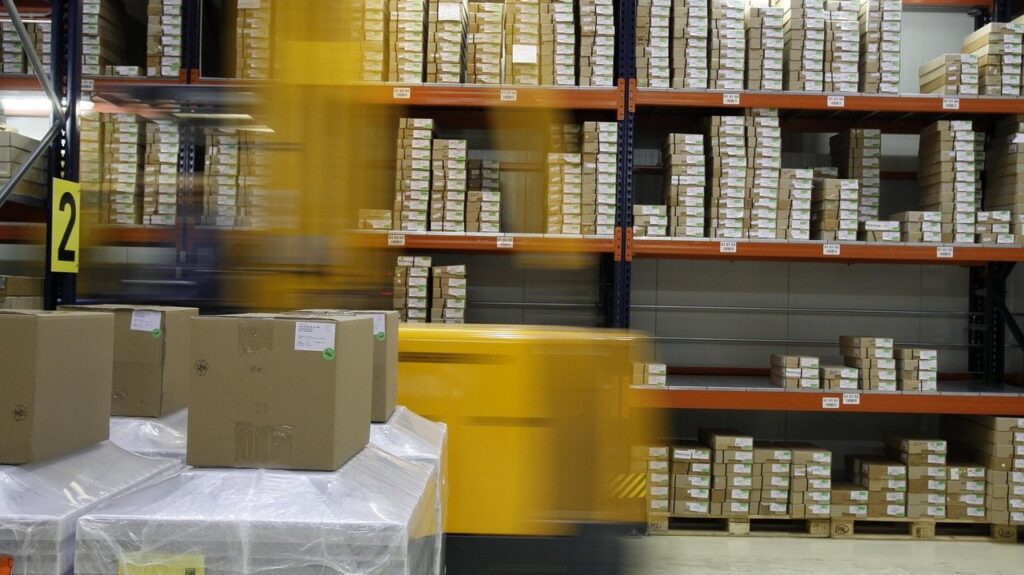
Photo: pallets with cartons in a warehouse, by delphinmedia, Pixabay. The inside measurements are those published by Blue Water Shipping, read on 19 November 2026; we worked out the counts from them. Containers differ by a few centimetres: check the container you are given before a load planned to the last pallet.
Planning a shipment? Request a quote with every fee included upfront, or talk to our team in Tunisia: +216 70 295 255, info@kyranislogistics.com.

Comments
Ask a question or share your experience.
No comments yet. Be the first to ask a question.