
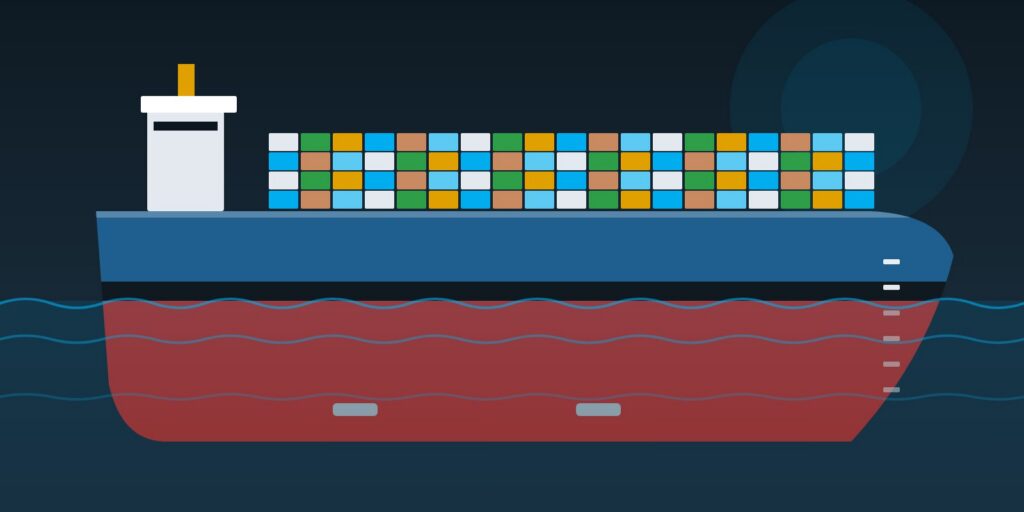
Look at a ship in dry dock and you will see it: the hull is blue, green or black on top, but almost always dark red underneath. The red is not decoration. It is a special paint that keeps the sea from growing on the ship.
Paint against life in the sea
Below the waterline the hull is always in the water, and the water is alive. Within days, bacteria and algae form a slime; then weed, barnacles, mussels and tubeworms settle on it. A fouled hull is rough, drags more water with it and needs more fuel to keep its speed. It can also carry these species from one sea to another. The red layer is antifouling paint: it slowly releases small amounts of a biocide, mostly copper, that stop organisms from settling.
Why red?
The colour comes from the main ingredient. Most antifouling paints use cuprous oxide, a red copper compound, as their biocide, and it gives the paint its red-brown colour. The habit is older than paint: wooden warships were covered with copper sheets below the waterline from the 18th century, and the shine of copper bottoms is still remembered in the expression "copper-bottomed" for something safe.
From copper sheets to modern paints
How the bottom is painted
Ships go to dry dock about every five years for their class survey, and the bottom is painted then. The work follows the same steps everywhere:
- The dock is drained and the hull is washed with high-pressure water to remove growth and loose paint.
- Rusty or damaged areas, sometimes the whole bottom, are blasted with grit down to bare steel.
- One or more coats of anticorrosive primer, usually epoxy, protect the steel.
- A tie coat helps the antifouling grip the primer.
- Two or three coats of antifouling follow, often in slightly different shades so that wear shows at the next inspection.
- New zinc or aluminium anodes are fitted against corrosion, and the boot-top and draught marks are repainted.
Modern self-polishing paints wear away slowly as the ship moves through the water, so the surface stays fresh and keeps releasing its biocide until the next dry dock.
And the colours above?
Above the boot-top, a ship wears its owner's colours: the light blue of Maersk, the green of Evergreen, the magenta of ONE. Below, some ships are black or grey, and silicone foul-release coatings, which stop growth from sticking instead of poisoning it, come in other colours too. But red remains the rule you will see in almost every port.
Why it matters for your freight
A clean hull is a matter of fuel. The IMO notes that even a thin layer of slime increases a ship’s fuel consumption and emissions, which is why lines care about the paint under their ships. Less fuel means lower costs and less CO₂ per container. Estimate the CO₂ of your own shipment with our freight tools, read how to ship with less carbon, or meet the 10 largest container lines whose hulls you see in Radès.
Sources
- IMO: Anti-fouling Systems Convention (AFS)
- IMO: Biofouling
- Wikipedia: Anti-fouling paint
- Wikipedia: Copper sheathing
Inspired by a short video on the subject; facts checked against the sources above in October 2026.
Planning a shipment? Request a quote with every fee included upfront, or talk to our team in Tunisia: +216 70 295 255, info@kyranislogistics.com.

Comments
Ask a question or share your experience.
No comments yet. Be the first to ask a question.