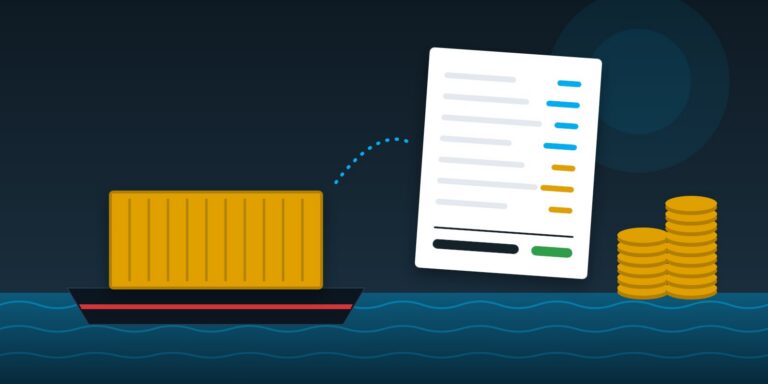
Two freight quotes for the same shipment can look very different. One shows a low headline rate. The other is higher, but complete. When the final invoice arrives, the first one often turns out to be the more expensive. Knowing how a quote is built helps you compare offers fairly and plan your costs.
The building blocks of a quote
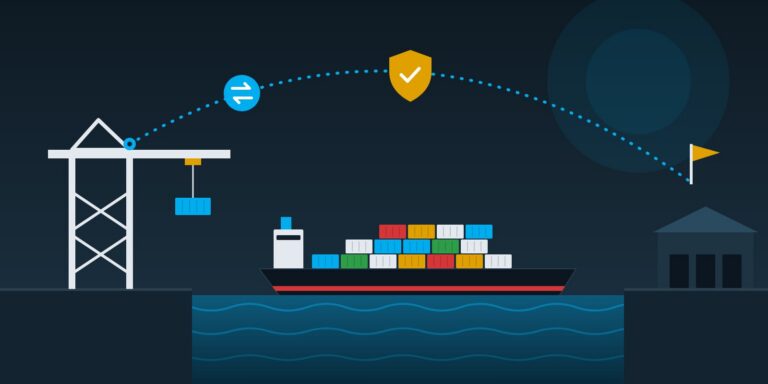
A door-to-door quote is a chain of separate costs. Each one belongs to a stage of the journey.
- Pick-up or pre-carriage: collecting the goods from the shipper and bringing them to the port, airport or depot.
- Origin handling: terminal handling charges (THC) at the port or airport of departure, and loading.
- Export documentation and customs clearance at origin.
- Main freight: the sea, air or road leg itself.
- Surcharges: a fuel surcharge (called BAF, bunker adjustment factor, in sea freight), and sometimes a currency adjustment factor (CAF) to cover exchange rate movements. Carriers may add security, peak season or congestion surcharges.
- Destination handling: terminal handling charges and other port or airport fees at arrival.
- Import customs clearance at destination. Duties and taxes are usually shown separately, because they depend on the goods and are set by the authorities.
- On-carriage and delivery to the receiver’s door.
- Cargo insurance, if requested.
Which parts the seller pays and which the buyer pays depends on the agreed Incoterms rule. A quote should make clear which stages it covers.
Chargeable weight: why size matters as much as weight
Transport space is limited by volume as well as by weight. A large but light shipment uses space that could carry heavier goods. That is why freight is charged on the chargeable weight: the higher of the actual weight and a volume-based weight.
- Air freight: the volumetric weight is usually length × width × height in centimetres, divided by 6,000. In other words, 1 cubic metre counts as about 167 kg.
- Sea freight, shared container (LCL): rates are per “weight or measure” (W/M). One cubic metre is treated as 1,000 kg, and you pay on whichever figure is higher.
- Road freight, groupage: a common rule is 1 cubic metre = 333 kg, though some carriers charge per loading metre or per pallet place instead.
- Full containers and full trucks are charged per unit, within the weight limits for the equipment and the route.
An example: a pallet of 120 × 80 × 150 cm weighing 180 kg has a volume of 1.44 m³. By air, the volumetric weight is about 240 kg, so you pay for 240 kg. By LCL sea freight, the figure is 1.44 W/M, because 1.44 m³ counts for more than 0.18 tonnes. By road groupage, about 480 kg would be charged. Good packing that reduces volume can lower the cost on every mode.
Costs that appear later
Some costs are not known when the quote is made, because they depend on what happens during the shipment:
- Demurrage, detention and storage, if containers or goods stay at the port, or with the receiver, longer than the free time allows (see our article on demurrage and detention).
- Customs inspections: extra handling, scanning or physical examination ordered by customs.
- Waiting time for trucks at loading or unloading.
- Changes to the booking, the delivery address or the documents.
A good quote names these possible costs and explains how they are charged. Then you know what can change, and why.
How to compare two quotes
- Check that both quotes cover the same stages, from the same place to the same place.
- Look for “subject to” lines and charges listed “at cost” or “as per tariff”. Those are open amounts.
- Compare the validity date and the transit time, not only the price.
- Check the weight and volume used. A quote based on a lower volume than the real one will be corrected later.
- Ask whether destination charges are included. In sea freight they can be a large share of the total.
Why we quote with every fee included
At Kyranis Logistics we quote with every fee included upfront. We list each stage, so you can see what you are paying for and plan your budget with confidence. If a cost could arise later, we tell you in advance and explain how it would be charged. Give us accurate weights, dimensions, the type of goods and the pick-up and delivery addresses, and we will build a quote for air, ocean, road or express freight from Tunisia to more than 220 countries.
Planning a shipment? Request a quote with every fee included upfront, or talk to our team in Tunisia: +216 70 295 255, info@kyranislogistics.com.