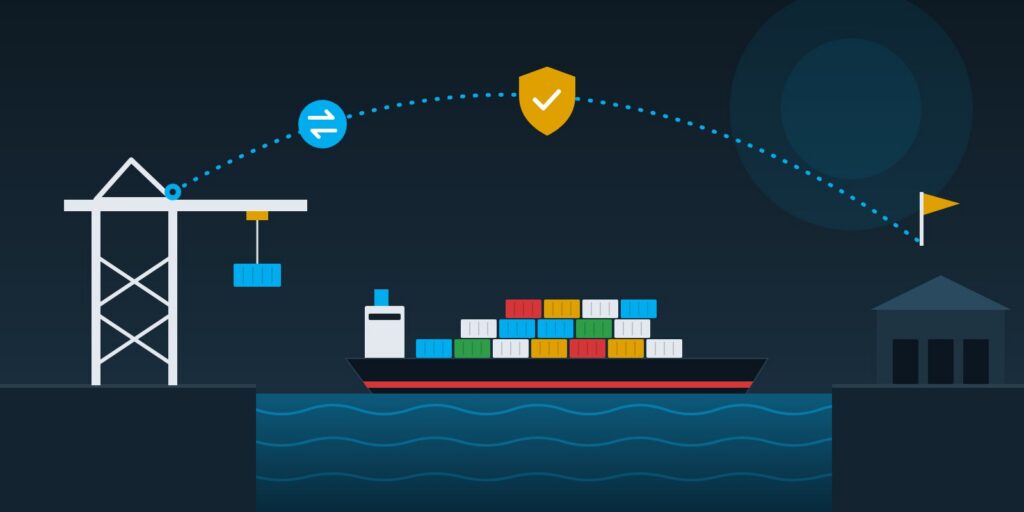
FOB and CIF are the two Incoterms rules you see most often on sea freight contracts and invoices. They look like opposites, yet they share a point many buyers miss: under both rules the risk passes to the buyer at the same moment, once the goods are loaded on board the ship at the port of shipment. What changes is who books and pays for the sea freight, and who insures the goods.
FOB and CIF at a glance
FOBFree On Board · named port of shipment, e.g. FOB Sfax
- The seller packs the goods, takes them to the port, clears them for export and loads them on board the ship chosen by the buyer.
- The buyer books and pays the sea freight, insures the goods if they wish, and pays the unloading, import clearance and duties.
- The risk passes when the goods are on board at the port of shipment.
CIFCost, Insurance and Freight · named port of destination, e.g. CIF Marseille
- The seller does everything required under FOB, and also books and pays the sea freight and insures the goods up to the port of destination.
- The buyer pays the charges at destination not included in the freight, import clearance and duties, and the delivery to their premises.
- The risk passes at the same moment as under FOB: when the goods are on board at the port of shipment.
Who pays and who carries the risk, stage by stage
The chart follows a shipment from the seller’s warehouse to the port of destination. The blue bars show the stages the seller is responsible for, the dark bars those of the buyer.
- Seller’s warehouse
- Export clearance
- Loading on board
- Sea freight
- Port of destination
FOB · who pays
FOB · who carries the risk
CIF · who pays
CIF · who carries the risk
The dashed line marks the loading on board. From there, the buyer carries the risk under both rules.
The two risk bars are identical. Under CIF the seller pays for a sea voyage during which the goods already travel at the buyer’s risk. If the cargo is damaged at sea, the buyer claims from the insurer, under the policy the seller took out, not from the seller.
The insurance under CIF is only a minimum
Incoterms 2020 only require the seller to buy the minimum cover, Institute Cargo Clauses (C), for at least 110% of the contract price. Cover (C) protects against major events such as fire, the ship sinking or running aground, and general average, but not against theft, rough handling or water damage. If your goods are fragile or valuable, agree in the contract that the seller buys cover (A), or buy extra cover yourself. Under FOB the choice of cover is yours from the start.
A worked example
An exporter in Sfax sells a 20-foot container of olive oil to a buyer in Marseille. Here is how an FOB price becomes a CIF price.
| Goods, packed for export | €39,400 |
| Transport to the port, export clearance, loading | €600 |
| FOB Sfax price | €40,000 |
| Sea freight Sfax to Marseille | €1,150 |
| Insurance, cover (C), 110% of the price | €70 |
| CIF Marseille price | €41,220 |
Illustrative figures. Freight and insurance change with the season, the route and the goods.
A CIF price is not dearer than an FOB price: it contains the same costs, paid by the other party. To compare offers fairly, ask a forwarder for the freight and insurance on the FOB offer and add them before comparing it with a CIF offer.
When to choose FOB, when to choose CIF
- Buyers choose FOB when they have their own forwarder or freight rates, and want to choose the shipping line, the transit time and the insurance.
- Buyers choose CIF for small or occasional shipments, when the seller gets better freight rates than they would.
- Sellers choose CIF to quote a complete price up to the buyer’s port, keep control of the booking and ship on their own schedule.
- Sellers choose FOB when they do not want to handle freight, insurance or claims once the goods are loaded.
Three mistakes to avoid
- Using FOB or CIF for containers. Both rules are made for sea transport where the goods are loaded on board directly, such as bulk cargo. A container is handed over at the terminal days before loading, and in between the seller carries the risk without controlling the goods. For containers, the ICC recommends FCA (Free Carrier) instead of FOB and CIP (Carriage and Insurance Paid To) instead of CIF; CIP also requires broader insurance, cover (A).
- Leaving out the place and the version. Always write the rule with a precise port and the edition, for example “FOB Sfax Incoterms® 2020” or “CIF Marseille Incoterms® 2020”.
- Forgetting the charges at destination. Under CIF, terminal handling and unloading at the port of destination are often not in the freight the seller paid. The buyer receives them on arrival with the import fees, so ask what is included before signing.
How Kyranis Logistics helps
From Tunisia we work on both sides of FOB and CIF contracts every day: we book the freight and the insurance for exporters who sell CIF, and we organise the pick-up at the port of shipment for importers who buy FOB. Read our guide to all 11 Incoterms rules, or ask us which rule fits your next contract before you sign.
Planning a shipment? Request a quote with every fee included upfront, or talk to our team in Tunisia: +216 70 295 255, info@kyranislogistics.com.