
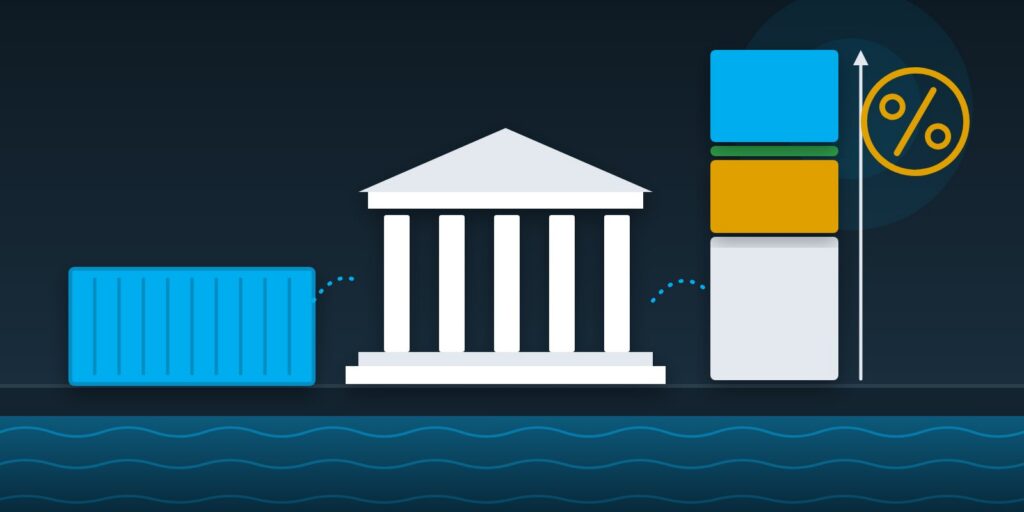
Before you order goods from abroad, it pays to know what customs will ask for when they arrive in Radès or Sfax. The duties and taxes are not a mystery: they follow a fixed chain, from the value of the goods to the VAT at the end. Once you know the chain and the code of your product, you can estimate the bill before you sign with your supplier.
The chain, step by step
Each step is calculated on a base that already includes the steps before it. That is why the order matters:
- Customs value (CIF)
- Customs duty
- Consumption duty, for some goods
- FODEC 1%
- VAT
It all starts with the product code
Every product has a code in the customs tariff, built on the international Harmonized System. The code decides the customs duty, whether a consumption duty applies, which VAT rate is used and whether any permit is needed. The Tunisian customs publish the tariff online (Tarif Web 2026 on douane.gov.tn): with the right code you see the rates for your goods.
The base is the customs value: the price of the goods plus the sea or air freight and the insurance up to the Tunisian port (CIF), converted to dinars. If you buy FOB, the freight and insurance are added to your invoice to reach that value.
The four layers
- Customs duty. A percentage of the customs value, set by the tariff line. The origin of the goods matters: goods of European Union origin usually enter free of customs duty under the association agreement, but only with a valid proof of origin (an EUR.1 certificate or an origin declaration on the invoice). From China, Turkey or elsewhere, the rate of the tariff line applies, unless a trade agreement says otherwise.
- Consumption duty. Only on some goods, such as vehicles, alcoholic drinks and certain other products. When it applies, it is calculated on the value plus customs duty.
- FODEC. A 1% charge for the fund for industrial competitiveness, on the value plus customs duty. It cannot be recovered later.
- VAT. Usually 19%, with reduced rates for some goods. It is charged on the value plus all the duties above. A company registered for VAT can normally deduct import VAT later, but it has to be paid at clearance, so it weighs on your cash flow.
Depending on the goods and the importer, small fixed fees or an advance on income tax may be added. Your customs agent lists them on the clearance bill.
An example: the same goods, two origins
Take goods with a customs value of 50,000 dinars, no consumption duty and VAT at 19%. To show the effect of the origin, we assume a customs duty of 20% on the tariff line. This rate is an example; yours depends on the code of your goods.
| Customs value (CIF) | 50,000 TND |
| Customs duty | 10,000 TND |
| FODEC 1% | 600 TND |
| VAT 19% | 11,514 TND |
| Duties and taxes | 22,114 TND |
| Customs value (CIF) | 50,000 TND |
| Customs duty | 0 TND |
| FODEC 1% | 500 TND |
| VAT 19% | 9,595 TND |
| Duties and taxes | 10,095 TND |
Rounded. VAT is calculated on the value plus duty plus FODEC (60,600 and 50,500 dinars).
The difference of about 12,000 dinars comes from the customs duty alone, and from the VAT charged on top of it. It also shows why a missing EUR.1 is so expensive: without it, goods made in Europe pay the full rate.
Five mistakes that raise the bill
- A wrong product code. A code that is too broad or simply wrong can mean a higher rate, a fine or a blocked container.
- No valid proof of origin. An EUR.1 that arrives late, is filled in wrongly or is missing means the full duty. Read EUR.1 and proof of origin.
- An invoice customs do not believe. If the declared value looks too low, customs can set their own value, and the duties follow it.
- Forgetting the cash for VAT. VAT is paid at clearance, even if you recover it later.
- Counting only duties and taxes. Port charges, storage and late documents add their own costs; see what makes up the price of a container from China.
How we help
Send us the product description, the supplier’s invoice or pro forma and the origin before you order. Our team checks the tariff code with you, estimates the duties and taxes, and tells you which documents the supplier must provide. When the goods arrive, we handle the customs clearance in Radès or Sfax.
Sources
- Tunisian Customs: Tarif Web 2026, the customs tariff (codes and rates)
- Tunisian Ministry of Finance: taxes and VAT
- World Customs Organization: what the Harmonized System is
- European Commission: EU trade relations with Tunisia (association agreement)
- finco.tn: FODEC in Tunisia, rate and calculation
Checked on 28 October 2026. Rates change with each finance law: for your goods, the tariff line and your customs agent are the reference.
Planning a shipment? Request a quote with every fee included upfront, or talk to our team in Tunisia: +216 70 295 255, info@kyranislogistics.com.

Comments
Ask a question or share your experience.
No comments yet. Be the first to ask a question.