
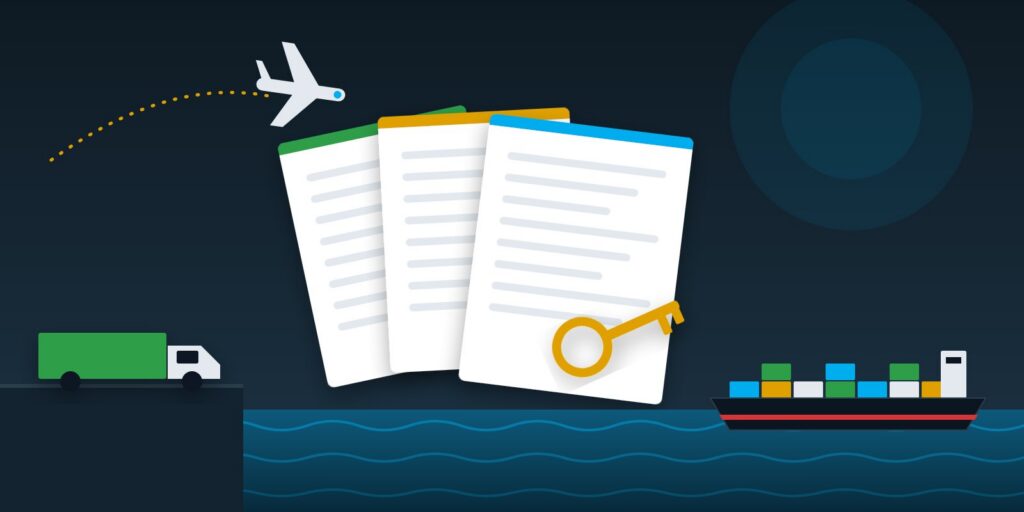
Every shipment travels with a transport document. It looks like paperwork, but it decides who can collect the goods at the other end, whether a bank will pay under a letter of credit, and how fast your cargo leaves the port. Here is what each document does, and the mistakes that hold cargo up.
The three jobs of a bill of lading
- A receipt: the carrier confirms it has received the goods, how many packages, and in what condition. A "clean" bill of lading has no remarks; a "claused" one notes damage or missing packages, and banks usually refuse it.
- Evidence of the contract of carriage: the terms on the back, the ports, the freight (prepaid or collect) and the carrier's liability.
- A document of title: whoever holds an original, correctly endorsed, can claim the goods. That is why it can be sold, pledged to a bank or used in a letter of credit.
Original, telex release, sea waybill: which one?
- Original bill of lading (to order): issued as a set, usually three originals. One original, handed in at destination, releases the cargo and the others are void. Needed for letters of credit and when the seller wants to be paid before the buyer gets the goods.
- Straight bill of lading: made out to a named consignee; only that consignee can take the goods, and it cannot be transferred by endorsement.
- Telex (or express) release: the originals are surrendered at the port of loading and the carrier tells its agent at destination to release the cargo without paper. Fast, no courier, no risk of lost originals.
- Sea waybill: not a document of title. The named consignee collects the goods by showing who they are. Best between companies that trust each other or within one group.
House and master bills of lading in groupage (LCL)
When your goods travel in a shared container, two bills of lading exist. The shipping line issues a master bill of lading (MBL) to the consolidator for the whole container; the consolidator issues a house bill of lading (HBL) to each shipper for their part. At destination, the container is opened at a container freight station and each consignee collects its goods against the house bill of lading, through the consolidator's agent. Ask your forwarder which document you will receive and who releases the cargo at arrival.
The four transport documents side by side
| Document | Mode | Document of title? | Originals | How the goods are released |
|---|---|---|---|---|
| Bill of lading | Sea | Yes (when made out to order) | Usually 3 | Against one original, or a telex release |
| Sea waybill | Sea | No | None needed | To the named consignee |
| Air waybill | Air | No | 3 (carrier, consignee, shipper) | To the named consignee, usually on arrival notice |
| CMR consignment note | Road | No | 3 (sender, goods, carrier) | To the consignee named in the note, who signs it |
The air waybill
Air cargo moves too fast for paper to follow, so the air waybill is never a document of title: the goods are released to the consignee named on it. In consolidated air freight there is a master air waybill from the airline and a house air waybill from the forwarder, as at sea. If the seller wants security before release, the consignee is often a bank, or payment is agreed before shipping.
The CMR consignment note
International road transport, for example by truck and ferry between Tunisia and Europe, travels under the CMR consignment note. It proves the contract and the condition of the goods when the driver loads them, and the consignee signs it at delivery. Any visible damage must be written on it at that moment: it is the first piece of evidence in a claim.
How cargo is released at Radès or Sfax
For a container arriving by sea in Tunisia, the usual steps are:
- the shipping line's agent sends an arrival notice to the consignee or its forwarder;
- the consignee hands in an endorsed original bill of lading, or the agent has received the telex release, and freight and local charges are paid;
- the agent issues the delivery order (bon à délivrer);
- the customs declaration is filed and the goods are cleared;
- port charges are paid and the container is picked up, ideally within the free days.
Every day lost waiting for an original that is still with the courier or the bank can cost demurrage. If the seller has been paid, ask for a telex release.
Mistakes that hold cargo up
- names, addresses or the notify party different from the invoice or the letter of credit;
- a description, weights or number of packages that do not match the packing list;
- "freight prepaid" or "collect" that does not match the agreed Incoterm;
- a shipped-on-board date after the latest date in the letter of credit;
- originals sent late or lost (a bank guarantee is then needed to release the cargo);
- remarks on the bill of lading because of poor packing.
Check the draft bill of lading before it is issued: corrections afterwards cost time and fees. Our document checklist for shipping from Tunisia to the EU lists the other papers, our guide to demurrage and detention explains the port costs of waiting, and cargo insurance covers what the carrier does not.
Planning a shipment? Request a quote with every fee included upfront, or talk to our team in Tunisia: +216 70 295 255, info@kyranislogistics.com.

Comments
Ask a question or share your experience.
No comments yet. Be the first to ask a question.