
Every Incoterms rule answers a question that is easy to overlook when the price is negotiated: who clears the goods through customs, on the way out and on the way in? The answer decides who lodges the declaration, who pays the duties and taxes, and who waits when customs asks a question. This guide gives the split for the 11 rules of Incoterms 2020, then the two rules that cause most trouble, and what the rule changes in the customs value.
Who clears customs under each rule
Clearing the goods means lodging the customs declaration and bearing its cost. The rules split this work between the seller and the buyer:
| Rule | Export clearance | Import clearance | Import duties and taxes |
|---|---|---|---|
| EXW (Ex Works) | Buyer | Buyer | Buyer |
| FCA (Free Carrier) | Seller | Buyer | Buyer |
| CPT (Carriage Paid To) | Seller | Buyer | Buyer |
| CIP (Carriage and Insurance Paid To) | Seller | Buyer | Buyer |
| DAP (Delivered at Place) | Seller | Buyer | Buyer |
| DPU (Delivered at Place Unloaded) | Seller | Buyer | Buyer |
| DDP (Delivered Duty Paid) | Seller | Seller | Seller |
| FAS (Free Alongside Ship) | Seller | Buyer | Buyer |
| FOB (Free On Board) | Seller | Buyer | Buyer |
| CFR (Cost and Freight) | Seller | Buyer | Buyer |
| CIF (Cost, Insurance and Freight) | Seller | Buyer | Buyer |
- Under EXW, the buyer clears the goods for export.
- Under DDP, the seller clears the goods for import and pays the duties and taxes.
- Under the nine other rules, each party clears customs in its own country: the seller for export, the buyer for import.
EXW: the buyer has to clear for export
Under EXW the seller only makes the goods available at its premises. The export declaration is the buyer's job, in a country where the buyer usually has no company and no customs broker.
The seller is not free of the matter either. In the Netherlands, for example, a seller who exports invoices without VAT and must be able to prove that the goods have left the country. Under EXW that proof depends on the buyer and on the buyer's forwarder.
The International Chamber of Commerce, which publishes the rules, advises FCA when export clearance may be difficult for the buyer. Under FCA the seller clears the goods for export, and it can still hand them over at its own premises.
DDP: the seller has to clear for import
DDP is the only rule under which the seller clears the goods for import and pays the duties and taxes in the buyer's country.
Some countries do not allow a foreign company to carry out the import formalities at all. Where it is allowed, the seller often has to register for VAT in that country or to appoint a local representative. This costs time and money, above all for a small company.
For the buyer, DDP looks comfortable, but the import declaration is lodged by someone the buyer did not choose: the buyer does not see the customs value, the HS code or the documents that were declared. On DDP offers from suppliers into Tunisia, see six terms to understand before you import from China.
The alternative is DAP: the seller still delivers to the agreed place, and the buyer clears the goods for import with its own customs broker.
The rule changes the customs value, not the duty rate
In the European Union and in Tunisia, customs charges duty on the customs value: the price of the goods plus the transport and the insurance up to the border. In the European Union, the border is the place where the goods enter the Union. In Tunisia, it is the Tunisian port: see how import duties are calculated in Tunisia. The rule on the invoice shows which of these costs are already in the price:
- EXW, FCA, FAS and FOB: the price stops before the main transport. The freight and the insurance up to the border are added to the invoice price.
- CFR and CPT: the freight is already in the price. CIF and CIP: the freight and the insurance are in the price.
- DAP, DPU and DDP: the price also covers the transport after the border. In the European Union, that part does not belong to the customs value, on condition that the invoice shows it as a separate amount; it is added back to work out the import VAT.
The duty rate does not change with the rule: it depends on the HS code of the goods and on their origin. See HS codes explained.
What to write on the invoice
- Write the rule in full on the commercial invoice: the three letters, the named place and the version, for example “FCA Sfax, Incoterms 2020”.
- Give this invoice to your customs broker: the broker needs the rule to work out the customs value.
- If the price includes transport after the border, ask the seller to show that transport on a separate line.
Sea, air or road: the split stays the same
FAS, FOB, CFR and CIF are written for sea and inland waterway transport only. For air freight and road transport, use one of the seven other rules. Customs clearance is split in the same way in both families: FCA splits it like FOB, CPT like CFR, and CIP like CIF. For all 11 rules, see Incoterms 2020 explained for exporters and importers.
Who lodges the declaration in practice
- The rule says who is responsible for the clearance and who pays for it. The declaration itself is usually lodged by a customs broker or a freight forwarder who acts for that party.
- The responsible party answers for what is declared: the HS code, the customs value and the origin of the goods. Check all three before the declaration is lodged.
- The other party has to help. On request, it provides the documents and the information that only it holds, such as the commercial invoice, the packing list or the proof of origin.
In short
- EXW: the buyer clears for export. DDP: the seller clears for import and pays the duties and taxes. The nine other rules: each party clears in its own country.
- FCA in place of EXW and DAP in place of DDP keep the same place of delivery, and leave each clearance to the party that knows its own customs.
- The rule does not change the duty rate. It changes which costs are added to the invoice price to reach the customs value.
What to do now
- Before you sign, read which clearance the rule puts on you, and check that you can carry it out in that country.
- Write the rule, the place and “Incoterms 2020” on the offer, the contract and the invoice, always in the same way.
- Not sure which rule fits? Read Incoterms 2020 explained for exporters and importers and FOB vs CIF: the key difference.
- We clear goods through customs in Tunisia for importers and exporters: see our customs clearance service, or ask us for a quote.
Sources
- ICC Academy: Incoterms 2020, EXW or DDP?
- Netherlands Chamber of Commerce (KVK): Incoterms explained (in Dutch)
- Netherlands Chamber of Commerce (KVK): how to determine the customs value of an import shipment
- Luxembourg, Single Window for Logistics: calculation of the customs value (PDF)
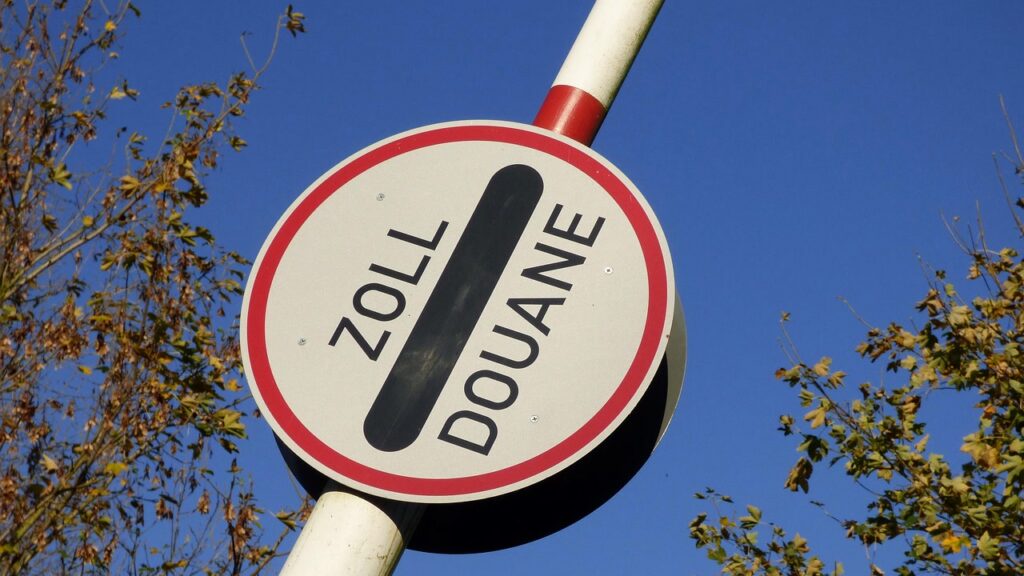
Photo: a customs sign at a border, by YvonneHuijbens, Pixabay. Incoterms is a registered trademark of the International Chamber of Commerce (ICC), which publishes the full text of the rules. This guide is a summary in our own words and does not replace that text.
Planning a shipment? Request a quote with every fee included upfront, or talk to our team in Tunisia: +216 70 295 255, info@kyranislogistics.com.

Comments
Ask a question or share your experience.
No comments yet. Be the first to ask a question.