
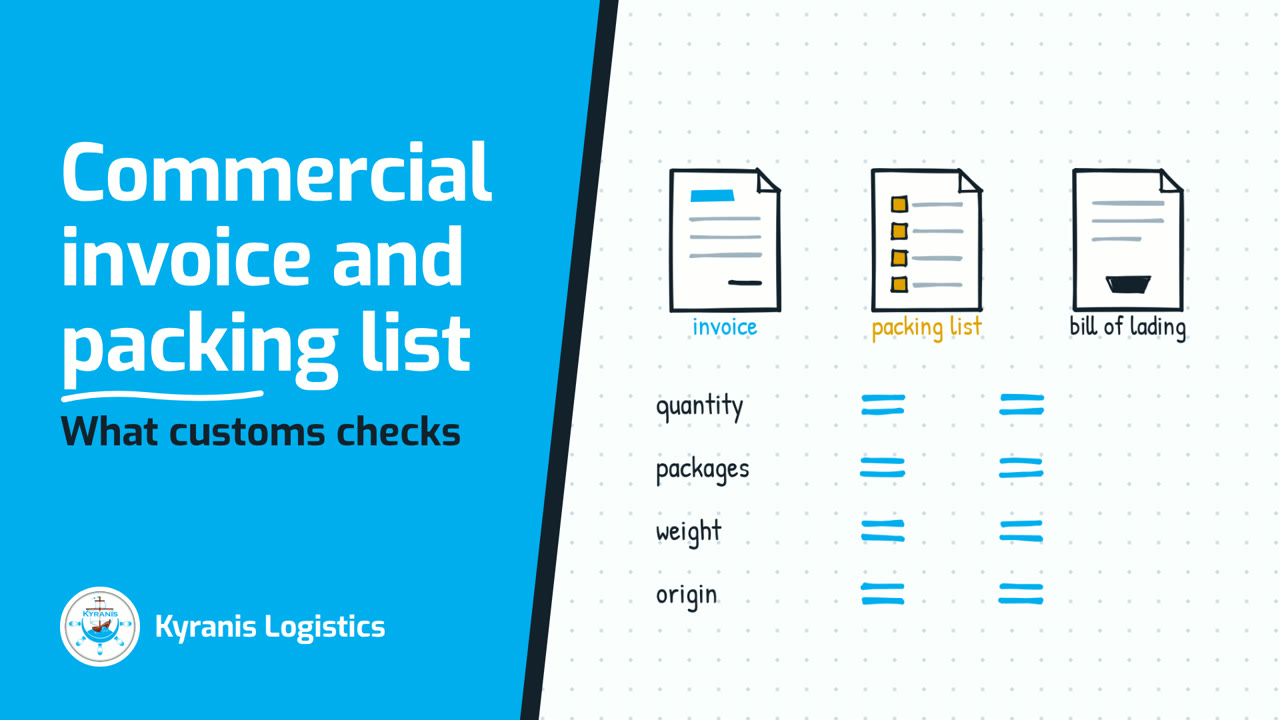
Two documents travel with almost every shipment: the commercial invoice, which says what was sold and for how much, and the packing list, which says what is in each package. Customs reads the first to calculate duties and taxes, and the second to check what is in a package. Both must be complete, and they must agree.
Two documents, two jobs
- The commercial invoice records the sale between seller and buyer: the parties, the goods, the quantities, the prices and the terms. In the buyer's country it is the document customs uses to assess import duties and taxes, and the bank may need it for the payment.
- The packing list itemises the contents of each package, box or pallet, with weights, measurements and the goods inside. The forwarder uses it to know weights and work out freight; customs uses it to check a particular package.
A pro forma invoice is something else: a quotation in the form of an invoice, with no accounting value. Customs clears goods on the final commercial invoice.
What the commercial invoice must show
A few countries ask for their own form, but most accept the seller's invoice if it contains everything customs needs. These are the fields to check before the goods leave:
| Field | Why it matters |
|---|---|
| Seller and buyer, with full names and addresses | Customs must know who sold and who bought; if the goods go to someone else, name that consignee too. |
| Invoice number and date | It ties the invoice to the payment, the transport document and the declaration. |
| A precise description of each item | What it is, what it is made of and what it is used for. A product code or SKU alone is not a description. |
| HS code | Not always required, but it speeds up clearance at both ends; see our guide to HS codes. |
| Quantity and unit of each item | The same quantities must appear on the packing list. |
| Unit price, total and currency | Every item needs a value, even a free sample: a value of zero is not accepted. |
| Incoterm and named place | It shows what the price includes, and so what customs adds to reach the value it taxes; see our guide to the Incoterms. |
| Freight, insurance and packing, each shown apart | Customs needs every charge on the goods to reach the value it taxes; the US rules, for example, require each one by name and amount. |
| Country of origin | It decides which duty rate applies and whether a trade agreement can lower it. |
| Payment terms and signature | The person responsible for the invoice, who can answer questions about the sale. |
What the packing list must show
- The number and marks of each package, as written on the package itself.
- What each package contains, item by item, in the same words and quantities as the invoice.
- The net and gross weight of each package; gross weight includes the packaging.
- The dimensions of each package, and the total number of packages.
- The total weight and volume of the shipment.
Put a copy inside the shipment, and one on the outside of a package, so that whoever opens it can check the contents at once. For pallets, the rules on wood are in our packing and palletising guide.
The documents must agree
The invoice and the packing list must match each other, and both must match the transport document and the certificate of origin. Check that these figures are the same everywhere:
- The quantity of each item on the invoice and on the packing list.
- The number of packages on the packing list and on the bill of lading or air waybill (see our guide to transport documents).
- The gross weight on the packing list and on the transport document.
- The description of the goods, and their origin on the invoice and on the certificate of origin.
A difference raises questions at the border: correct it before the goods leave, when it still costs nothing.
Importing into Tunisia
- The final invoice must list the parties and their details, the description of the goods, the unit price and quantity, the total price and the currency according to the Incoterm, the means of transport and the delivery time, and the payment terms.
- For goods that are free to import, the commercial invoice is the foreign trade title that the importer domiciles with an approved bank. The bank checks the content of the invoice and the product's tariff code (NGP); the domiciliation of a commercial invoice is valid for 6 months.
- Where a product is subject to technical control, the importer sends a file through the TTN platform before the goods arrive, in Arabic, French or English: the domiciled invoice, the certificate of origin, the packing list, the technical file and the notice of arrival.
- With the customs declaration, the importer provides the commercial invoices, the certificate of origin, the bill of lading and any other document the rules require. How duties are then calculated is explained in our guide to import duties in Tunisia.
Exporting from Tunisia to Europe? The full list of documents is in our document checklist, and proof of origin in our guide to EUR.1.
Common mistakes
- A vague description such as "spare parts" or "textiles", or only a product code.
- "No commercial value" or a value of zero on samples and free goods.
- Freight and insurance included in the price but not shown, or missing entirely.
- Quantities or weights on the packing list that differ from the invoice or the transport document.
- Only a total weight, with no weight per package.
- The country of origin missing, or different from the certificate of origin.
In short
- The invoice tells customs what was sold and for how much; the packing list tells it what is in each package.
- Describe every item precisely, give it a value, and show freight, insurance and packing apart.
- Quantities, packages, weights and origin must be the same on every document.
- In Tunisia the final invoice is domiciled with a bank, which checks it and its tariff code before the goods are cleared.
Send us your invoice and packing list before the goods leave and we check them against the booking and the transport document. Need a price? See how to request a freight quote, or contact us.
Sources
- Ministry of Commerce and Export Development, Tunisia: Manual of import procedures (in French)
- US Code of Federal Regulations, 19 CFR 141.86: contents of invoices
- Flexport: Commercial invoice and packing list, what you need to know
- International Trade Administration: Commercial invoice
- International Trade Administration: Packing list
Read on 22 November 2026. The rules for the invoice differ from one country to another: check those of the country of import, or ask us.
Planning a shipment? Request a quote with every fee included upfront, or talk to our team in Tunisia: +216 70 295 255, info@kyranislogistics.com.

Comments
Ask a question or share your experience.
No comments yet. Be the first to ask a question.