
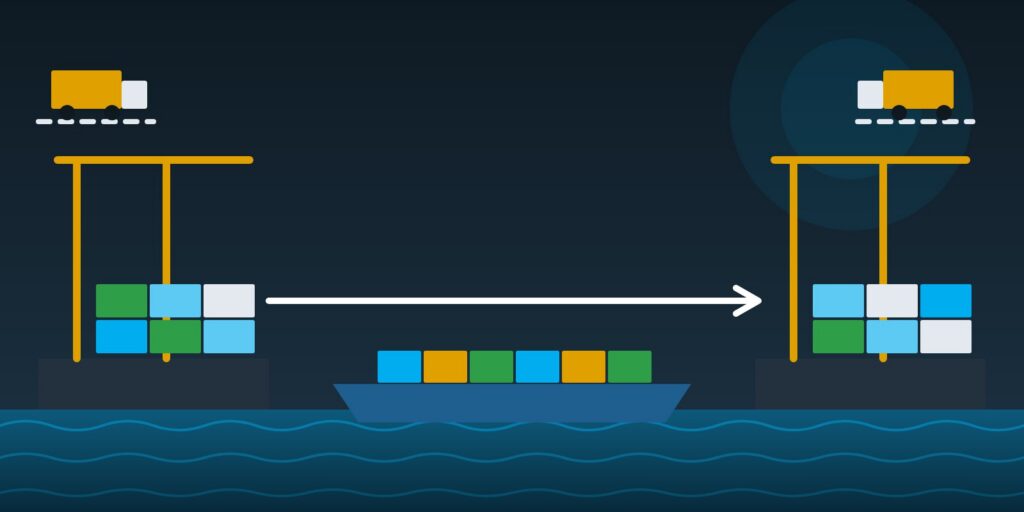
On a sea freight quote or a bill of lading you often see two letters, a slash and two more: CY/CY, CY/Door, Door/Door. These are service terms. They say where the shipping line takes charge of your container and where it hands it back, and so which costs its freight covers. Two quotes with different service terms are not comparable, and a misunderstanding here is a cost nobody quoted.
What CY and CFS mean
- CY, container yard: the area of a port terminal where full containers are received before loading and wait after discharge, such as the container yards at Radès or Sfax.
- CFS, container freight station: a warehouse where shared-container (LCL) cargo is grouped into containers at origin and split again at destination.
The common service terms
- CY/CY: the shipping line carries the container from the yard at the port of loading to the yard at the port of discharge. You deliver the full container to the terminal and collect it at destination.
- Door/CY: the line also collects the container at the shipper's premises.
- CY/Door: the line also delivers the container to the consignee's address.
- Door/Door: the line or the forwarder handles both ends, from the factory to the consignee.
- CFS/CFS: the usual term for LCL; the goods are handed over and collected at the depots.
Who does the trucking
When the shipping line arranges the truck between the yard and the address, this is carrier haulage, and it is priced into the freight. When the shipper, the consignee or their forwarder arranges it, this is merchant haulage. Merchant haulage is often cheaper and more flexible, but collecting the empty container, returning it on time and any detention are then your responsibility.
What a CY/CY rate does not include
- Trucking to the port of loading and from the port of discharge.
- Terminal handling charges at origin and destination, which many lines invoice separately.
- Customs clearance, duties and taxes at both ends.
- The delivery order and other destination fees.
- Demurrage, detention and storage once the free days are used up. See demurrage and detention.
Service terms are not Incoterms
A service term is agreed between the shipper and the shipping line. An Incoterm is agreed between the seller and the buyer, and says who pays which part of the journey. They work together: a sale FOB Radès can travel CY/CY, with the buyer paying the sea freight and arranging the collection at destination. Check that the service term on the booking matches the Incoterm in the contract, so that no leg is left unpaid or paid twice. See Incoterms 2020 explained.
An example from Tunisia
A factory near Sfax ships a 40-foot container to Hamburg on CY/CY terms. A truck brings the empty container to the factory, the goods are loaded and sealed, and the truck takes the container to the terminal at Radès before the cut-off: that trucking is merchant haulage, paid outside the sea freight. In Hamburg the consignee's broker clears the goods and a truck collects the container from the yard within the free days. A door-to-door quote would have included both truck legs and the terminal charges; the CY/CY rate looked cheaper because it covered only the sea leg.
Which one to choose
- CY/CY suits shippers who arrange the trucking themselves or through their forwarder, and want to compare ocean rates.
- Door/Door suits those who want one price and one contact for the whole journey.
- Whatever the term, ask for a quote that lists every fee, so that you compare the same journey. See how a freight quote is built.
At Kyranis we quote the whole journey, from your factory to your buyer's door or the reverse, and show which part each fee covers, so that a cheap ocean rate does not hide the costs around it.
Planning a shipment? Request a quote with every fee included upfront, or talk to our team in Tunisia: +216 70 295 255, info@kyranislogistics.com.

Comments
Ask a question or share your experience.
No comments yet. Be the first to ask a question.